





PET film removal can save an otherwise usable touch panel when the functional film on an OCA-bonded assembly needs replacing. The challenge is getting the film and adhesive off without taking part of the sensor with them.
Sometimes the problem is only in the top film: a scratch, trapped contamination or the wrong functional layer. Scrapping the whole assembly can seem wasteful when the touch panel still works. Removing the PET film is an option worth checking—but a clean-looking peel is only half the job.
The real question is whether the panel underneath will still work properly, accept a new bond and meet the finished product’s requirements. That depends on the materials, the way the panel is supported and where the adhesive lets go.
Built on years of practical rework experience
At VANESEN, PET film removal from OCA-bonded touch panels is an established process, developed through years of hands-on rework experience. Our approach goes beyond individual successful jobs: it brings together material assessment, panel support, controlled separation, residue handling and post-rework testing in a repeatable working method.
That experience helps us judge where separation should take place, how to protect the sensor and FPC, and which checks are needed before the panel returns to use. It also helps us recognize when a different material stack needs a change in approach. A mature process starts with understanding the assembly—not applying the same settings to every panel.
First, find out what is under the film
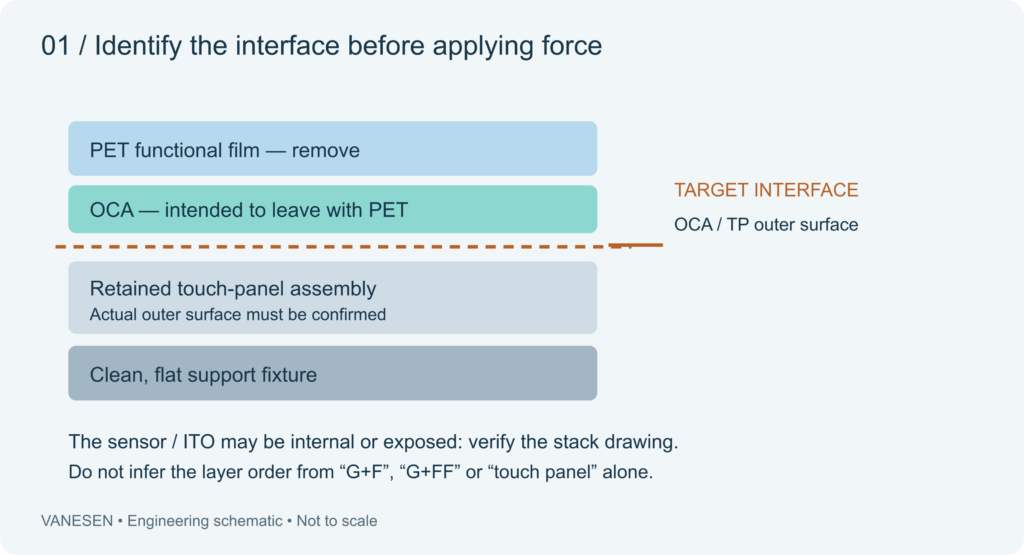
A typical assembly has a PET functional film bonded to a touch panel with optically clear adhesive, or OCA. Ideally, the OCA comes away with the PET, leaving the panel ready for inspection and, if needed, further cleaning.
But the surface underneath is not always glass. It could be a coated film or a surface close to a conductive layer. Some panels are relatively rigid; others contain thin film sensors that can stretch or separate if pulled. You cannot choose a removal method from the words “touch panel” alone.
Start with the layer drawing and material details. Identify the surface touching the OCA, the adhesive grade and thickness, and the position of the flexible printed circuit (FPC). The FPC is the flexible tail that connects the panel to its electronics. It needs protection throughout the job.
Watch where the adhesive lets go
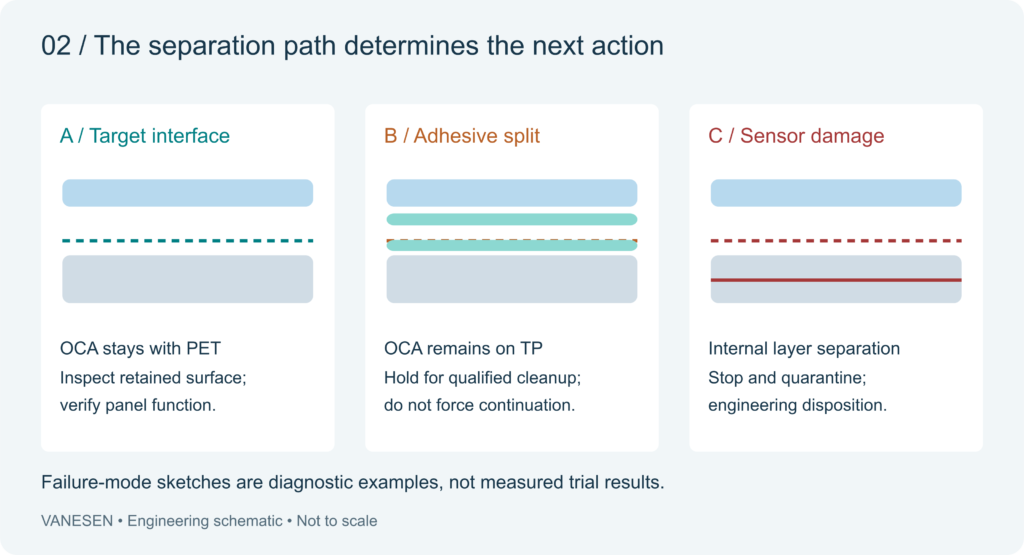
There are three quite different things that can happen during removal.
The best outcome is separation between the OCA and the panel surface. The film lifts, the adhesive stays with it and the panel remains flat on its support.
Another possibility is that the adhesive splits. Some comes off with the PET and some stays on the panel. That creates a cleaning job, and the cleaner must be suitable for everything it might touch—not just the adhesive.
The more serious problem is separation inside the panel itself. A coating or sensor film may lift with the OCA. At that point, pulling harder can turn a small damaged area into a much larger one.
Check both sides of the separated area as you go. Adhesive on the removed film does not, by itself, prove that the panel surface is intact.
Good support matters as much as a steady pull
Think of peeling a label from a thin plastic sheet. If the sheet follows the label, much of the movement goes into bending the sheet rather than separating the adhesive. A film-based touch panel can face the same problem, with much less room for error.
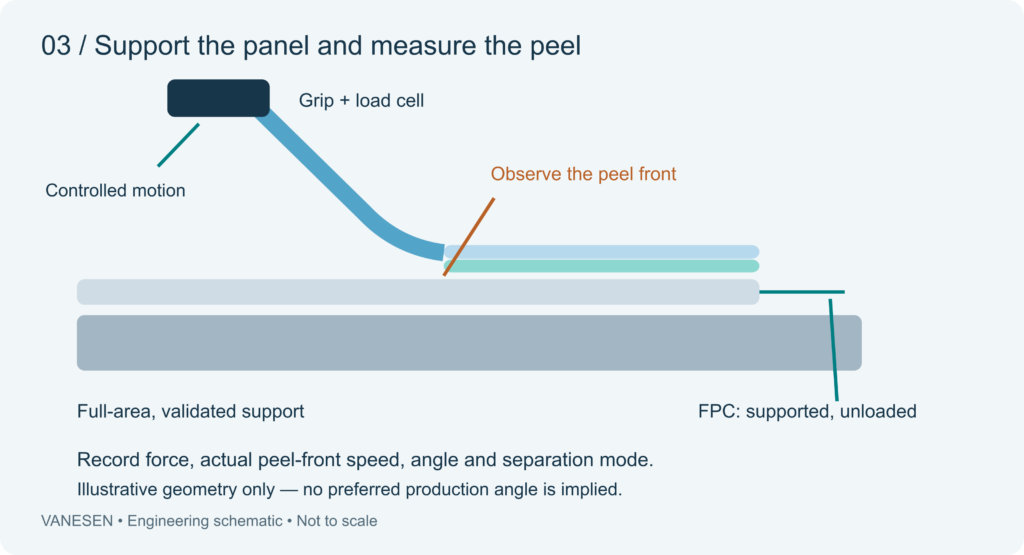
Support the panel on a clean, flat fixture. Avoid gaps that let it bow and pressure points that can mark the surface. If vacuum is used, check that it does not leave local impressions or distort the sensor.
Begin at an edge away from the FPC and sensitive traces. Make only enough of a lift to establish the separation, using a suitable non-metallic tool without scraping the retained surface. Then grip the PET and keep the movement controlled. The FPC should remain supported, with no pulling load on its connection.
For repeat work, use a fixture with force monitoring. A hand pull may feel smooth while hiding short force spikes. Recording the force makes it easier to spot changes and compare one trial with another.
There is no single “safe” speed or angle
“Pull slowly” sounds sensible, but it is not a complete process. OCA changes its behavior with the speed of removal, temperature and the surfaces it bonds to. A setting that gives clean removal on one stack may leave residue or lift a layer on another.
The peel angle matters too. Folding the film back over itself changes the way the load reaches the bonded area. It also bends the removed film differently. Neither a 90-degree nor a 180-degree peel should be treated as the best choice for every panel.
Use spare or scrap assemblies to compare a small number of controlled settings. Keep the materials, support and bonding history consistent so you can see what the change actually does. Record the force, residue, panel movement and test results afterward. When comparing different fixtures, check how quickly the separation line moves across the panel; the machine’s pulling speed may not tell the whole story.
The useful setting is the one that gives repeatable removal and a panel that passes inspection and testing. The lowest force reading alone does not decide it.
Will heat make removal easier?
It may help with some adhesive systems, but it can also change the amount of residue or affect other parts of the assembly. A temperature the adhesive can survive in service is not automatically a good temperature for taking the panel apart.
Begin with room-temperature trials where the material guidance allows. If the result is poor, check the OCA and panel supplier’s information before trying heat or cooling. Measure the panel temperature rather than relying only on the heater display, and check the electrical and touch performance after the trial.
The same approach applies to residue removal. A solvent that dissolves the OCA may also affect an ink, coating or the adhesive at the FPC connection. Test the cleaner, contact time and drying method on representative samples first. Avoid soaking the assembly in an untested solvent.
When should you stop?
Stop if the panel starts lifting from its support, bends unexpectedly or shows signs of a layer coming away. A sudden increase in force, torn adhesive or movement at the FPC connection also needs attention.
Do not keep pulling just to finish the piece. Photograph the affected area and check what has changed. The cause may be the material combination, the fixture or the separation path. Continuing before you know which one can destroy useful evidence as well as the panel.
Check the panel before putting it back into use
Once the film is off, inspect the surface for scratches, cracks, dents, lifted layers and remaining adhesive. Then compare the panel with the checks recorded before removal.
Test touch response across the whole active area, including the edges and corners. Check for inaccurate positions, missed touches and unstable behavior. Where the design allows, check the circuits for opens, shorts and resistance changes against the product specification. Inspect the FPC and its connection as well.
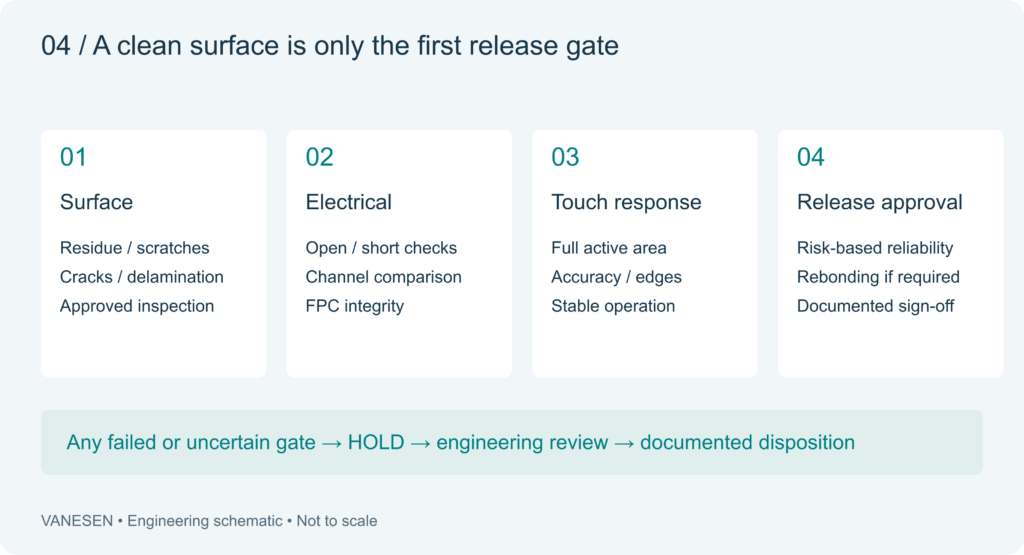
If a new film will be bonded onto the panel, inspect and test that finished assembly too. A surface can look acceptable before bonding yet show bubbles, optical marks or poor adhesion afterward. Any required environmental or life testing should reflect the product’s use and customer requirements.
Keep the results with the material and process records. When an OCA grade, panel coating, PET thickness or fixture changes, review whether the earlier results still apply. One successful removal is a useful start; consistent results across representative parts are what make the method suitable for regular work.
Is your assembly a good candidate for rework?
The answer starts with a few practical details: what the OCA is bonded to, how the sensor is built, how long the assembly has been bonded and what the panel needs to do afterward.
VANESEN brings years of accumulated rework experience and a mature process to this assessment. From reviewing the material stack to controlling separation and checking the retained panel, we treat rework as a complete process, with the finished assembly’s requirements in view.
If you are considering PET film removal, send us your layer drawing, OCA grade and thickness, PET details and photographs showing the FPC position. Include whether the panel will be bonded again and the checks it must pass. We can then discuss how our established process can be applied to your assembly and what needs to be confirmed before regular production.
Talk to VANESEN about your assembly
For a closer look at process checks, read our OCA rework guide for touch panels and PET films. More on display assembly: Qu'est-ce que le collage optique ? · Intégration d'écrans pour les interfaces homme-machine (IHM) industrielles