




Optical bonding in one minute
Optical bonding joins a display, touch sensor or cover glass across the viewing area with an optically transparent material. Compared with an air-gap construction, a properly designed bonded stack can reduce reflections at internal interfaces, improve perceived contrast in bright surroundings and produce a more integrated front assembly. It does not automatically increase LCD brightness, eliminate external surface glare or make an enclosure waterproof.
1. What is optical bonding?
In industrial human-machine interfaces (HMIs), the front assembly may contain cover glass, a projected-capacitive (PCAP) or resistive touch sensor, optical adhesive and an LCD module. Optical bonding replaces a selected air cavity with an optical medium whose refractive index is closer to that of adjacent transparent layers. The exact layer order depends on the sensor and display architecture.
Optical bonding is different from perimeter or edge bonding. A perimeter bond attaches the stack around its border while retaining an air space in the viewing area. Full-area bonding fills the designed optical interface.
2. Four bonding structures engineers should distinguish
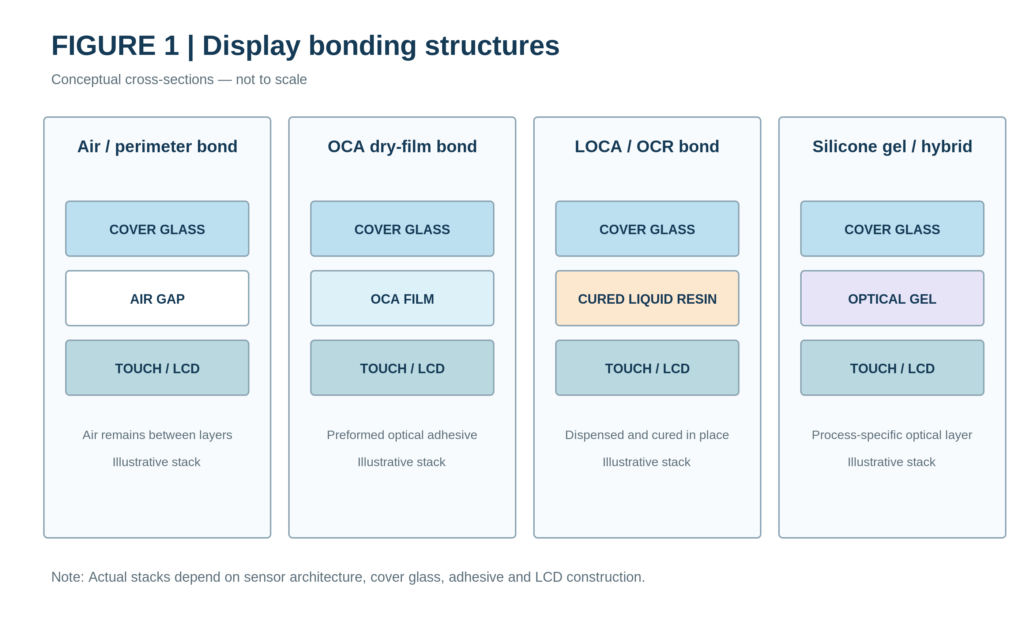
Air-gap / perimeter bonding
The cover or touch assembly is mechanically secured at the edges. An air gap remains over the active display area. This can simplify certain repairs, but the additional interfaces may create visible reflections. Mechanical clearances, dust control and condensation risk still require evaluation.
OCA dry-film bonding
Optically clear adhesive (OCA) is supplied as a controlled-thickness film, commonly laminated between suitable flat or moderately contoured transparent surfaces. It can support consistent thickness and a clean process when the stack geometry, surface quality and lamination conditions are compatible. Bubble control, stress and rework behavior need validation.
LOCA / OCR liquid bonding
Liquid optically clear adhesive (LOCA), also called optical clear resin (OCR) in some supply chains, is dispensed into the optical gap and cured using a material-specific process. It can accommodate certain gaps and shapes that are difficult for film, but requires tight control of dispensing, overflow, cure uniformity, shrinkage and contamination. UV curing is common for some formulations, not universal.
Silicone gel and hybrid bonding
Silicone-based optical layers and hybrid processes may be considered where compliance, thermal movement or a particular service strategy matters. Formulation, cure mechanism and long-term behavior vary significantly. The term “hybrid bonding” is not one standardized material or process; request the supplier’s exact stack definition.
3. How optical bonding improves readability
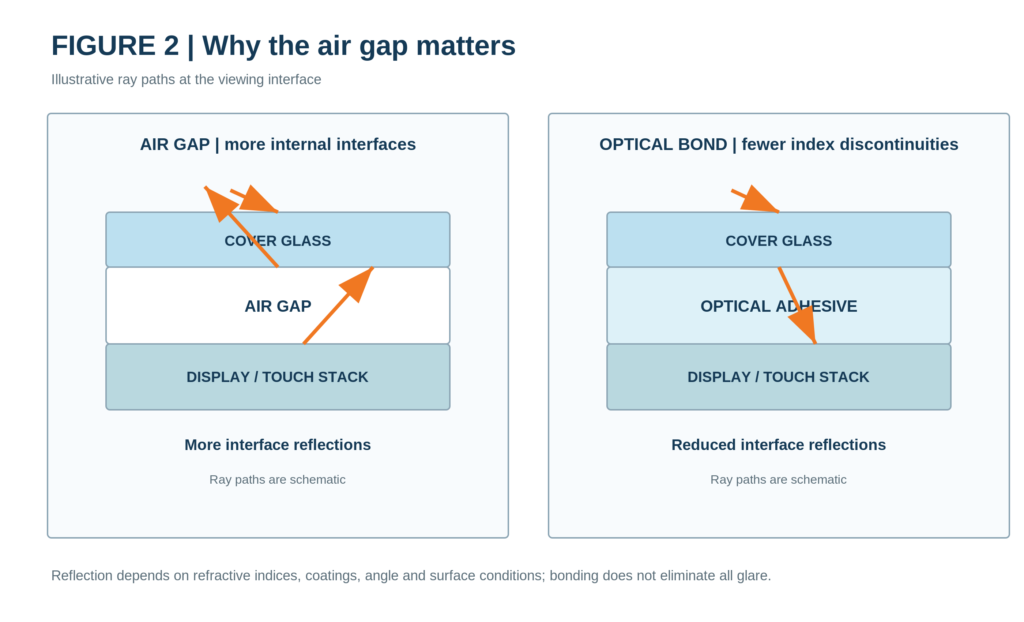
Every transition between materials with different refractive indices can reflect some incident light. A glass-to-air boundary typically creates a larger index discontinuity than a glass-to-optical-adhesive boundary. Filling the air gap can therefore reduce reflections inside the display stack. Surface anti-reflective coatings and anti-glare treatments address different parts of the optical problem and may still be needed.
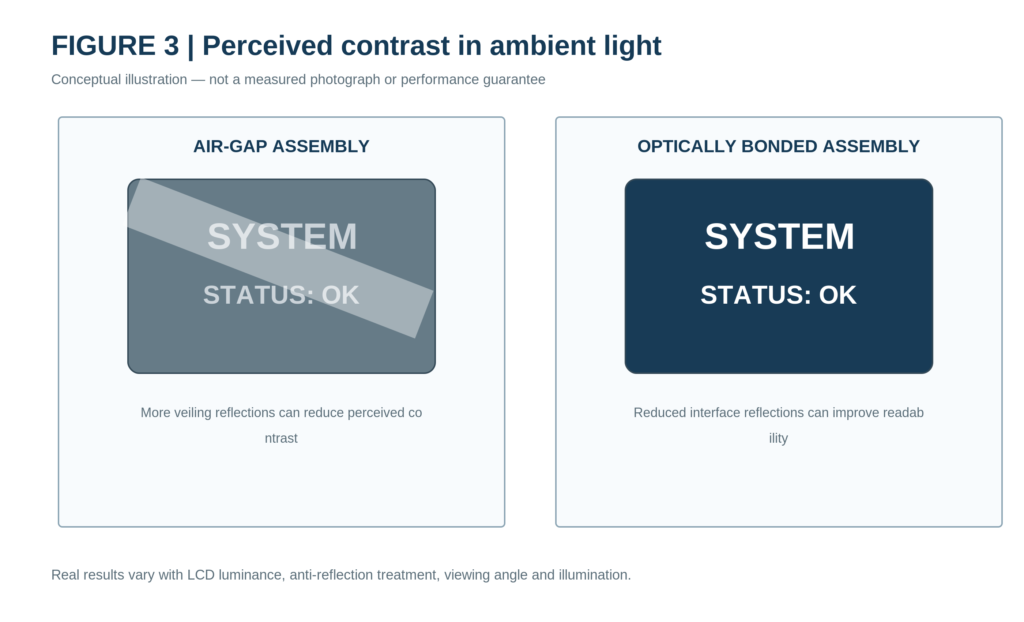
The practical benefit is often better perceived contrast and readability under ambient illumination, rather than an increase in the LCD’s emitted luminance. Results depend on glass coatings, display brightness, optical material, illumination geometry and viewing angle. Claims such as a fixed percentage reflection reduction should be backed by measurements on the actual assembly.
4. Engineering trade-offs: what to check before choosing
| Parameter | Why it matters |
| Performances optiques | Reflectance, haze, transmittance, color shift and readability |
| Mechanical stack | Flatness, gap uniformity, tolerances and edge clearance |
| Environment | Operating/storage temperatures, humidity, UV exposure and thermal cycling |
| Reliability | Bubbles, delamination, yellowing, cracks and stress on the LCD |
| Touch function | PCAP tuning, grounding, cover thickness and glove/wet-use requirements |
| Serviceability | Rework yield, repair process and replacement economics |
| Production | Size, equipment capacity, takt time, yield and inspection criteria |
5. How to select OCA, LOCA or gel
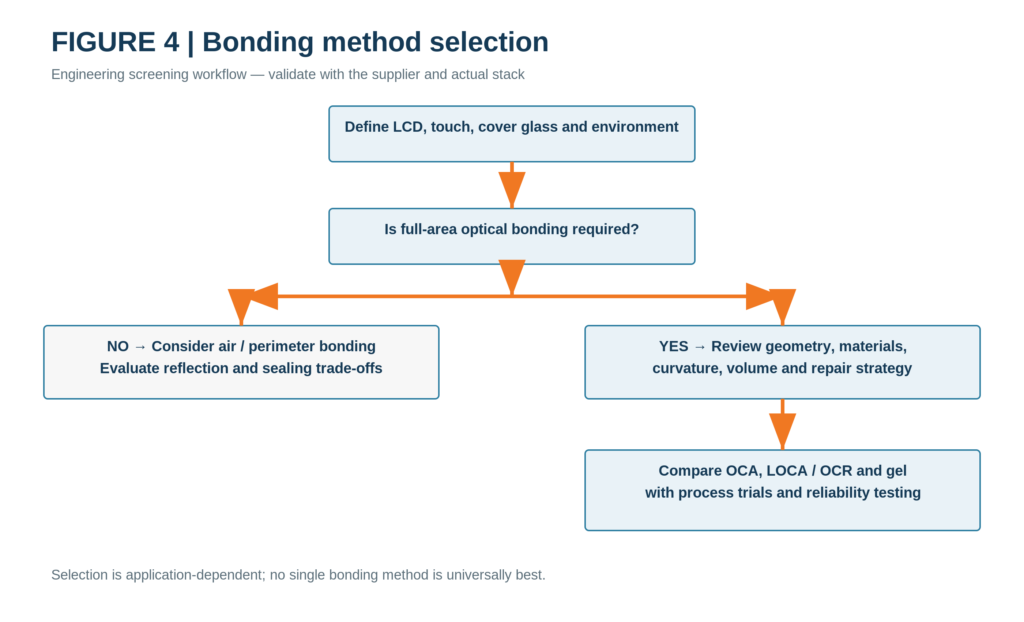
Begin with the complete stack drawing, not just the LCD diagonal. Confirm the cover glass dimensions and coatings, touch-sensor architecture, LCD construction, adhesive gap, cosmetic requirements, expected annual volume and operating environment. Then compare process feasibility and lifecycle risk.
OCA is often a practical candidate for repeatable planar assemblies with suitable lamination geometry. LOCA/OCR may be useful where liquid filling offers a process advantage. Silicone or hybrid systems may address particular compliance or thermal-mechanical requirements. These are screening tendencies, not universal rules; actual material data and pilot builds govern the decision.
6. Validation checklist for industrial and railway HMIs
- Review dimensional stack-up and bonding area
- Inspect cosmetic quality for bubbles, particles, overflow and Newton-ring-like artifacts where relevant
- Measure optical performance on agreed samples and test conditions
- Check touch performance after bonding, including wet or glove operation if required
- Run application-specific thermal, humidity, vibration and UV tests as appropriate
- Define acceptance criteria, traceability, repairability and process controls
For railway, medical and other long-life industrial applications, qualification should follow the product’s actual installation and customer specifications. A material data sheet alone does not qualify the assembled HMI. Likewise, IP ratings belong to the validated enclosure or installed assembly, not to the optical bond in isolation.
7. Frequently asked questions
Is OCA better than LOCA?
Neither is universally better. The choice depends on geometry, optical requirements, process controls, production scale and reliability targets.
Does optical bonding make a screen waterproof?
No. Optical bonding may remove an internal air space, but ingress protection depends on the complete enclosure design, seals, interfaces and verification tests.
Does optical bonding increase screen brightness?
It does not increase the LCD backlight output. It can improve apparent visibility by reducing selected internal reflections.
Can a bonded touch screen be repaired?
Some constructions can be reworked, but feasibility and yield vary by adhesive, glass, touch architecture and equipment. Repair strategy should be evaluated before volume production.
Discuss your display integration project
VANESEN supports industrial display integration, including optical bonding, touch integration, cover glass, mechanical design and assembly. Share your display size, layer stack, environmental requirements and target volume to review a practical bonding approach.
For the wider assembly process, read our display integration guide for industrial HMI. Review our testing and delivery service for project-specific verification, or contact VANESEN to discuss your display stack.
3 réponses